Ebook The Object-Oriented Thought Process (4th Edition) (Developer's Library)
It's needed currently to have this publication by you. It is not as hard as formerly to find a publication. The modern technology always is the very best way to locate something. As right here, we are the internet site that always gives the book that you need. As The Object-Oriented Thought Process (4th Edition) (Developer's Library), we give it in the soft data. You might not to publish it as well as get it as papers and pilled one by one. Reading this book in computer system gadget or laptop can be likewise same. In addition, you could likewise review it on your gizmo or Smart device. Now, that's offered enough.
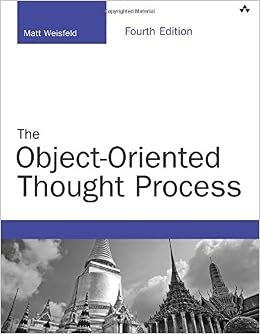
The Object-Oriented Thought Process (4th Edition) (Developer's Library)

Ebook The Object-Oriented Thought Process (4th Edition) (Developer's Library)
Obtain your favorite book just in this site! This is a great site that you can go to daily, in addition every time you have leisure. As well as the factors of why you have to enter this website are that you could learn lots of collections publications. Style, types, and also publishers are various. However, when you have read this web page, you will obtain a book that we primarily use. The Object-Oriented Thought Process (4th Edition) (Developer's Library) is the title of guide.
The look of this publication and the title is actually interesting. Nevertheless, the web content is likewise no much less interest. Every word that is used and also exactly how the author arranges the words making sentence and meaning are truly correct and appropriate. It's appropriate for today circumstance. Below, The Object-Oriented Thought Process (4th Edition) (Developer's Library) functions just how a publication is needed. All components of the great publications are required. Moreover, the crucial element that will attract the people to read is also given completely.
You could obtain guide by visiting to the link page of the book. It will not be recognized when you do not download the application. And then, you can keep it to the gadget. You know, as the developed and also advanced technology in these recent years, the activities and all points can be done by using or making use of the innovation. This is as exactly what to do to get The Object-Oriented Thought Process (4th Edition) (Developer's Library) in the soft file. You need to attach to the web as a typical point today.
And afterwards, when you really love to see how the requirements of this publication as good book, you can directly get it as fantastic book. This publication is really one more time advised in order to boost you to assume an increasing number of. When The Object-Oriented Thought Process (4th Edition) (Developer's Library) has been gathered, you should have understood exactly how this book is called for. So, which time should be the best time to start getting and also reading this publication? Immediately is the most effective response.
The Object-Oriented Thought Process, Fourth Edition An introduction to object-oriented concepts for developers looking to master modern application practices Object-oriented programming (OOP) is the foundation of modern programming languages, including C++, Java, C#, Visual Basic .NET, Ruby, and Objective-C. Objects also form the basis for many web technologies such as JavaScript, Python, and PHP. It is of vital importance to learn the fundamental concepts of object orientation before starting to use object-oriented development environments. OOP promotes good design practices, code portability, and reuse–but it requires a shift in thinking to be fully understood. Programmers new to OOP should resist the temptation to jump directly into a particular programming language (such as Objective-C, VB .NET, C++, C# .NET, or Java) or a modeling language (such as UML), and instead first take the time to learn what author Matt Weisfeld calls “the object-oriented thought process.” Written by a developer for developers who want to make the leap to object-oriented technologies, The Object-Oriented Thought Process provides a solutions-oriented approach to object-oriented programming. Readers will learn to understand the proper uses of inheritance and composition, the difference between aggregation and association, and the important distinction between interfaces and implementations. While programming technologies have been changing and evolving over the years, object-oriented concepts remain a constant–no matter what the platform. This revised edition focuses on interoperability across programming technologies, whether you are using objects in traditional application design, in XML-based data transactions, in web page development, in mobile apps, or in any modern programming environment. “Programmers who aim to create high quality software–as all programmers should–must learn the varied subtleties of the familiar yet not so familiar beasts called objects and classes. Doing so entails careful study of books such as Matt Weisfeld’s The Object-Oriented Thought Process.” –Bill McCarty, author of Java Distributed Objects, and Object-Oriented Design in Java Contents at a Glance 1 Introduction to Object-Oriented Concepts2 How to Think in Terms of Objects3 Advanced Object-Oriented Concepts4 The Anatomy of a Class5 Class Design Guidelines6 Designing with Objects7 Mastering Inheritance and Composition8 Frameworks and Reuse: Designing with Interfaces and Abstract Classes9 Building Objects and Object-Oriented Design10 Creating Object Models11 Objects and Portable Data: XML and JSON12 Persistent Objects: Serialization, Marshaling, and Relational Databases13 Objects in Web Services, Mobile Apps, and Hybrids14 Objects and Client/Server Applications15 Design Patterns
Your recently viewed items and featured recommendations
›
View or edit your browsing history
After viewing product detail pages, look here to find an easy way to navigate back to pages you are interested in.
Product details
Series: Developer's Library
Paperback: 336 pages
Publisher: Addison-Wesley Professional; 4 edition (March 23, 2013)
Language: English
ISBN-10: 9780321861276
ISBN-13: 978-0321861276
ASIN: 0321861272
Product Dimensions:
6.9 x 0.7 x 8.9 inches
Shipping Weight: 1.2 pounds (View shipping rates and policies)
Average Customer Review:
3.8 out of 5 stars
72 customer reviews
Amazon Best Sellers Rank:
#431,374 in Books (See Top 100 in Books)
The best audience for this book is a programmer who approaches coding procedurally and needs to be led in the direction of thinking object oriented. In fact, a number of chapters are flat out some of the best and clearest introductory material I've read on OOP. Some of the middle chapters of the book are just rearranged words saying the same thing in circles. You'll read it thinking something new will come of it, but it doesn't. The latter part of the book are misc chapters giving a short overview or discussion of things like UML, XML, JSON, Serialization, Marshaling, Web Services, and Design Patterns, and some of that is new in this fourth edition. These range from laughably cursory to excellent at times. Much of that material is obviously for beginners. The chapter on design patterns is probably the best introduction on the subject I've read, but it does suffer from the same problems as the rest of the book, as I'll note below.If you read the third edition, the same errors are there in this fourth. The editing problems are disappointing. Like on page 223 he says, "By now you should realize that this is an actual application...The fact that the code has a main method in it is a sure tip." OK, well, the code doesn't have a main method. It leaves you wondering, "What planet am I on, did I miss something?" Another example: At the end of chapters it seems like he inserts the wrong portions or odd choices of code. Just really inconsistent stuff like that. And then there are things like sentences from previous paragraphs that reappear again almost word for word. Not to mention things like sentences from previous paragraphs that seem to appear again almost word for word.I was tempted to give this book three stars because some of it is repetitious or pointless and especially because of the editing issues. Despite its generous portions of brilliance, I just didn't think the author should be rewarded for putting so little care into it as a whole, especially for what you would expect by a fourth rewrite! But I'll tell you, a lot of chapters are really excellent for the right audience. Also on the positive side, the code examples are very clear and to the point. While ideas are usually introduced with java samples, he also includes C# code and gives nice context to C++. It would be nice if the coding in the book was more practical, but it's usually the "model the world" kind of stuff which doesn't help you learn how object-oriented thinking applies to real coding.I should note that practically every chapter references "Object Oriented Design in Java" by Gilbert and McCarty, published in 1998. That book obviously really influenced the author's life.
The first chapter is profoundly enlightening. There is a reason I like to buy books on programming concepts rather than exclusively relying on the blogosphere. I spent a week at work trying to understand our legacy codebase and after reading the first chapter of this book I immediately starting to understand our codebase with much more clarity and fixed the issue we were dealing with very quickly. I also began to immediately see many ways in which the way things are currently implemented aren't correct and create more problems than help.---- UpdateI finished reading this book and all I can say is great things about it. The author understands the subject AND the reader so well that he nearly 100% of the time know exactly when to explain things a little more or less. My code has become so much cleaner as a result of reading this and my understanding of design patterns is much much better now. This was the foundational knowledge I was looking for that would tie together so many ideas like SOLID programming, separation of concerns, and as mentioned design patterns. I read this book in about 2 weeks because it was written in a language that makes it easy to absorb and fly through. I think I was ready for this knowledge as well after having written tons of programs without this solid background 'theory'.
I am back in school working on another degree in IT, so have to do some programming. I've had classes in a few scripting and programming languages, but don't work as a developer, so my programming skills are still "novice". I bought this book after a recommendation from a fellow classmate, and read it to supplement and review textbook Java programming coursework. For an experienced object-oriented programmer this is probably too basic of a book, but for a student or someone new to programming, the information here is clear and explanatory. Even if someone were looking at programming as a possible career, reading this book to get an idea if you can even get some basic OO concepts could be useful.
This is a great book for those who have never programmed or never got any formal education on object oriented programming. I was a MIS major and have pretty much been a SQL DBA straight out of college, so my skillset mainly revolved around T-SQL with some scripting knowledge in PowerShell. This book does a great job of breaking things down and using real world examples for explaining things such as Classes, Public and Private Types, Interfaces, Inheritance, and Polymorphism in layman's terms. It also goes into explaining the differences between "Structured" vs "Object" programming.If you ever read a beginner's book for any language and got lost whenever concepts such as instantiation, public/private classes/methods, why namespaces/libraries are named the way they are, how to access methods, etc. then this book is for you. I really enjoyed how it breaks down classes and explains best practices for determining what should be available on the interface. After reading this, I feel I can look at existing classes and know right away what it's trying to do. The author even does a nice job of explaining some of the history behind languages and the paradigm shift to object orientation programming. Overall, if you ever read tutorials or books regarding programming and wondered "why" things were written the way they were then this book does a good job of answering most of that.
The Object-Oriented Thought Process (4th Edition) (Developer's Library) PDF
The Object-Oriented Thought Process (4th Edition) (Developer's Library) EPub
The Object-Oriented Thought Process (4th Edition) (Developer's Library) Doc
The Object-Oriented Thought Process (4th Edition) (Developer's Library) iBooks
The Object-Oriented Thought Process (4th Edition) (Developer's Library) rtf
The Object-Oriented Thought Process (4th Edition) (Developer's Library) Mobipocket
The Object-Oriented Thought Process (4th Edition) (Developer's Library) Kindle