Get Free Ebook Pulphead: Essays
When you need a book to read now, Pulphead: Essays can be a choice since this is one of the upgraded publications to check out. It is sure that when you have new point to think about, you require inspirations to address t. when you have time to read, the books turn into one service to take. Even this publication is taken into consideration as new book, many people place their trust funds on it. It will certainly recognize you to be one of them that are falling in love to check out.
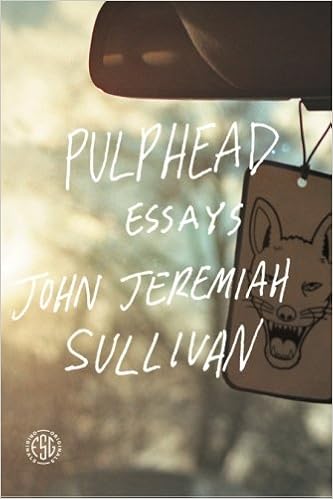
Pulphead: Essays

Get Free Ebook Pulphead: Essays
Checking out a book Pulphead: Essays is type of simple task to do every time you really want. Also reading every single time you want, this task will certainly not disturb your various other activities; lots of people generally read the books Pulphead: Essays when they are having the extra time. What regarding you? What do you do when having the extra time? Don't you spend for ineffective points? This is why you require to obtain the publication Pulphead: Essays and also aim to have reading practice. Reading this publication Pulphead: Essays will not make you worthless. It will offer much more advantages.
Reading ends up being on part of the life that ought to be done by everyone. Reading must be believed from earlier to be habit as well as hobby. Even there are many individuals with alternative leisure activities; it doesn't indicate that you can not appreciate reading as other activity. Reading Pulphead: Essays is one of the methods for you to boost your high quality of the life. It is such assumed in the many resources.
From the title, we will certainly also show you the topic related to define. When you really require this sort of resource, why do not you take it currently? This book will not just offer you the understanding as well as lesson concerning the subject, from the words that are made use of, it specify brand-new enjoyable thing. This Pulphead: Essays will certainly make you feel no concern to invest more time in reading.
When you have actually picked this book as your reading material in this time, you could take check out the additional option of the Pulphead: Essays to obtain. Juts discover it in this internet site. We likewise offer lots of collections of guides from several nations. Locate the link and obtain guide to download and install. The soft file of Pulphead: Essays that we offer is readily available to have currently. It will certainly not make you always remind regarding where when, but it is to advise that analysis will certainly constantly provide you compassion.
Named A Best Book of 2011 by the New York Times, Time Magazine, the Boston Globe and Entertainment Weekly
A sharp-eyed, uniquely humane tour of America's cultural landscape―from high to low to lower than low―by the award-winning young star of the literary nonfiction world.
In Pulphead, John Jeremiah Sullivan takes us on an exhilarating tour of our popular, unpopular, and at times completely forgotten culture. Simultaneously channeling the gonzo energy of Hunter S. Thompson and the wit and insight of Joan Didion, Sullivan shows us―with a laidback, erudite Southern charm that's all his own―how we really (no, really) live now.
In his native Kentucky, Sullivan introduces us to Constantine Rafinesque, a nineteenth-century polymath genius who concocted a dense, fantastical prehistory of the New World. Back in modern times, Sullivan takes us to the Ozarks for a Christian rock festival; to Florida to meet the alumni and straggling refugees of MTV's Real World, who've generated their own self-perpetuating economy of minor celebrity; and all across the South on the trail of the blues. He takes us to Indiana to investigate the formative years of Michael Jackson and Axl Rose and then to the Gulf Coast in the wake of Katrina―and back again as its residents confront the BP oil spill.
Gradually, a unifying narrative emerges, a story about this country that we've never heard told this way. It's like a fun-house hall-of-mirrors tour: Sullivan shows us who we are in ways we've never imagined to be true. Of course we don't know whether to laugh or cry when faced with this reflection―it's our inevitable sob-guffaws that attest to the power of Sullivan's work.
Product details
Paperback: 369 pages
Publisher: FSG Originals; 1 edition (October 25, 2011)
Language: English
ISBN-10: 0374532907
ISBN-13: 978-0374532901
Product Dimensions:
5.1 x 1 x 7.5 inches
Shipping Weight: 6.4 ounces (View shipping rates and policies)
Average Customer Review:
4.2 out of 5 stars
98 customer reviews
Amazon Best Sellers Rank:
#127,757 in Books (See Top 100 in Books)
In "Unknown Bards", Sullivan's essay about American Blues music, we get this quote from Dean Blackwood of Revenant Records, "...I have always felt like there wasn't enough of a case being made for [blues musicians'] greatness. You've got to have their stuff together to understand the potency of their work." The same can be said about John Jeremiah Sullivan.Until now, Sullivan's essays have entered the public sphere only piecemeal through periodicals like GQ, Harper's Magazine, and The Paris Review. With "Pulphead", we get the first compilation of Sullivan's essays, and only the second book of his ever published. What emerges from this collection, more so than if one were to read these essays on their own, is a uniquely talented American writer and voice.Sullivan's prose is humble and emotional, while never self-centered or overbearing.His prose is opposite that of a political pundit's, a sophist sportscaster, or "expert" social media consultant. Our society is quick to confuse wisdom with declarative opinions. From Sullivan, don't look for grandiose reformations of opinions into facts. Words like guarantee, definitely, undoubtedly are as foreign to Sullivan as pretentious qualifiers like, "My twenty years of successful leadership on the Hill..." Or, "I have been saying all along, and I will say it again, John Doe is the best athlete since..."Sullivan deals in grey. In his essays, he even takes self-deprecating swipes at his own credibility as a writer: "I don't know. I had no pseudo-anthropological moxie left." Or, "Ordinarily, one is tense about interrogating strangers, worried about freezing or forgetting to ask what'll turn out to be the only important question." Or about Axl Rose, who the entire essay "The Final Comeback of Axl Rose" was supposed to be about, "I don't know him at all."Such self-deprecation is uncommon from writers, and requires immense self-confidence. These swipes, in their humanity, though, have a way of increasing Sullivan's credibility. Such subtleties are the touch of a confident Velazquez at the height of his technical mastery.Sullivan's technical mastery of his craft, his tantalizing, crackling prose, is what allows the reader to learn not only more about the subject of the Sullivan's eye, but also about Sullivan himself.Whether John Jeremiah Sullivan is writing about pop culture, youth movements, religion, music, or geology, there is always reverberating just beneath the surface of the lead story the narrative of Sullivan's own life.The story of Sullivan's life has a way of turning the reader inward. The reader becomes a reader of his or her own story.In "Upon This Rock", Sullivan journeys to the Creation Christian Rock Festival. We learn that Sullivan began this journey with the mindset that his trip to Creation would be "a lark". Instead, Sullivan provides a vivid account of a humbling, human journey of self-exploration, "I went back to the trailer and had, as the ladies say where I'm from, a colossal go-to-pieces. I started to cry and then stopped myself for some reason. I felt nonsensically raw and lonely. What a d%ickhead I'd been, thinking that this trip would be a lark."In this raw emotion, and through empathy for the people he is writing about, Sullivan achieves at Creation some clarity about his own life, and his own relationship with spirituality.Sullivan's prose in "Upon This Rock" stands up to today's frenetic, digital, fragmented, and hyperlinked world. His prose is like a glorious mixed-media work of art: a orange yarn glued on top of a black and white photo, underneath and oil painting of an purple-pink evening sky.Some critics are quick to draw parallels between Sullivan's style and that of David Foster Wallace: the patched together, disjointed brilliance. A more apt description of Sullivan is that he is a self-assured, humble, updated, and less egotistical Hunter S. Thompson.In his journey to Kingston to meet the "Last Wailer," the influence of fellow Kentuckian Hunter S. Thompson is most apparent: "There was a big open-air bar. `Mind if we smoke?' Llewis asked...We rolled a two-sheeter under a giant sign that said NO GANJA SMOKING." Llewis is not the "Last Wailer". He is just a tour guide, helping Sullivan with the essay. The essay is about neither Llewis, nor Sullivan, but in a way it does become about them, and about something bigger than just Bunny Wailer.Like with Thompson's writings, in Sullivan's essays, we are always presented the author's story. But Sullivan's first person narrative is far less "Gonzo" than Thompson's.Sullivan strikes a tone that is more gently, lovingly irreverent than that of "The Decadent and The Depraved" (Thompson's brilliant essay about the Kentucky Derby). Sullivan replaces Thompson's vitriolic I'm-not-a-member-of-the-Country-Club-so everyone-who-is-is-a-small-minded-sycophant bitterness, with an even-though-a-Country-Club-can-be-a-culturally-empty-place-there-are-individuals-inside-of-it-that-I-am-sure-have-some-vulnerability-some-humanity-that-I-can-write-about empathy.Sullivan opens his heart to his subjects. While his methods- for interviewing and writing alike- may not be ganja-free, and are unconventional- they are far from bitter, angry, or temperamental. A warm self-confidence, respect for mankind, self-deprecation, and desire to know pulsates through Sullivan's writing like a bubbling brook.In "Peyton's Place" Sullivan has crafted a shrewd commentary on pop culture, parenthood, and of the way media in its many forms is blurring the lines between what is real and unreal, public and private. With a keen sense of humor, and a big heart, Sullivan has an adroit and playful way of mending his language to match his subject, "The brunet's question had given me a small, surprising tilt of nostalgia. Did we know that we used to be on a show? Did we know that?" One can almost hear the unwritten "OMG!!" at the end of that sentence.Sullivan doesn't play with language in this way to be demeaning; rather, he uses it as a way to show empathy, and to self-reflect. "Brunet" is a carefully, brilliantly chosen word. This superficial identification is similar to the kinds of superficiality that occurs within the very sitcom being filmed in Sullivan's home- a show that Sullivan is neither admonishing nor praising, because he is both removed from the show, but also has an indirect hand in fostering its production.Sullivan doesn't deal in absolutes. He is constantly exploring through his pen. He is trying to determine what is really real, who he really is, how he relates to another person, what it all means. His language will disarm you with humor, with a familiarity and modernity that carries his words- with a Trojan horse-like slippage- into your psyche for a long, long while. "Pulphead" is a collection of essays that proves Sullivan is a young and lively Southern writer not to be overlooked.
Thematic strength isn't what you usually find in a book of journalistic essays, but apparently Sullivan is drawn to strangeness wherever it rears its head. And in this world, strangeness is de rigueur. These essays wander from a Christian rock festival to a brother of Sullivan, who exhibits all sorts of odd behavior after a near-electrocution. Then there's a near-encounter with Guns n' Roses' Axl Rose, a fey old gay man, then America's ancient cave dwellers and those who find and sell their artifacts. Perhaps the oddest two are one on Jamaica's Rastafarians and another on a naturalist's theory of why animals - worldwide - seem to be increasingly attacking humans. Two pieces on reality shows could very well have been left out - their oddness speaks for itself.It would be easy to treat each of these subjects as caricatures, but that isn't Sullivan's angle. There's always something a bit confessional in his work; he's very rarely cynical, and he seems to be at least a little invested in each subject he approaches. As such, his writing is both expository and personal, and there's not a little bit of charm to each. It's as if Sullivan wants us to admit to a lot of this strangeness in each of us. And that's a refreshing point of view in a literary world replete with postmodernist cynicism.
I devoured this book in two days. Based on what I'd read beforehand, I was expecting a book of pop criticism, a la Klosterman. Instead, what I got was much more varied and profound. Generally speaking, the collection is a secret history of the United States; many of the essays walk a line between what can be known, and what cannot, in our American past. For example, Sullivan spends an hour, in one of the essays, trying to decipher the lyrics to a haunting, mostly-forgotten blues song. In another, he imagines an encounter between a cave painter, thousands of years ago, and a cave painting made thousands of years before that. The painting is an object of wonder and mystery to this historical would-be artist, just as his paintings will eventually be for us.A whole book of nothing but very clever essays on mainstream American pop culture can end up making the reader himself feel trapped at the carnival. By instead turning pop culture (The Real World, Axl Rose, etc) into another chapter in an ongoing American story, Sullivan elevates both his subject and his own full-length debut.
John Jeremiah Sullivan is a talented writer who shows great compassion on subjects not normally shown empathy. A great example, and probably the second-best essay of the collection behind "Mr. Lytle: An Essay," is the very first of the collection--"On This Rock"--about Sullivan's travels to a Christian rock concert. He doesn't sneer, and he doesn't condemn. There is no hint of superiority. "John Jeremiah Sullivan" the character is presented as a bit of a clown (probably more so than is actually true . . . though maybe not, who knows). We are meant to laugh at him as much as with him. We learn JJS himself went through a Christian-phase in high school. By understanding and recognizing his empathy we are empathetic. We were once young, foolish, brave, stupid, sad, happy. We know these things. JJS reminds us. Great collection.Not a revolution for essays/magazine writing, but it's about as good as it gets without reworking the whole damn thing.
Pulphead: Essays PDF
Pulphead: Essays EPub
Pulphead: Essays Doc
Pulphead: Essays iBooks
Pulphead: Essays rtf
Pulphead: Essays Mobipocket
Pulphead: Essays Kindle